
It happens to the best of us. You’re cruising down the highway when your engine sputters, your dashboard lights up like a Christmas tree, and your car rolls to a dead stop. The heart-sinking reality: you need an emergency towing service — and you need to know what to do right now.
Whether it’s a blown tire, a dead battery, an overheated engine, or a mysterious mechanical failure, knowing the correct steps can mean the difference between a stressful disaster and a smooth, safe recovery. This complete 2026 guide walks you through everything — from the moment your car breaks down to the moment the tow truck arrives.
Why You Need a Plan Before Breakdown Happens
According to the American Automobile Association (AAA), vehicles over 10 years old are twice as likely to break down — and 400% more likely to need a tow to a repair shop. With millions of roadside breakdowns happening every year in the US alone, it’s not a matter of if — it’s a matter of when.
Having a plan saves lives. Stranded vehicles on busy highways contribute to secondary accidents every day. Knowing what to do keeps you, your passengers, and other drivers safe.
Step-by-Step: What to Do When Your Car Breaks Down
Step 1: Pull Over to Safety Immediately
The moment you sense a problem, begin slowing down gradually and steer your vehicle to the farthest right shoulder or emergency lane available. If you’re near a highway exit or rest area, try to reach it completely before stopping.
Once stopped, engage your parking brake and turn your wheels slightly toward the curb or road edge. This prevents your car from rolling back into traffic if your brakes fail.
Key tip: Never stop in a travel lane. Even a few extra feet off the road dramatically reduces your risk of a collision.
Step 2: Turn On Your Hazard Lights
Activate your emergency flashers the instant you pull over — or even while you’re still moving toward the shoulder. These blinking lights are your most important safety signal to other drivers.
Leave them running continuously until help arrives. Turn off all non-essential electronics to preserve your battery, but keep hazard lights and your phone charged as your top priorities.
Step 3: Stay Inside Your Vehicle
This step saves lives every year. Unless there is smoke, fire, or immediate danger — stay inside your car.
The Insurance Information Institute strongly advises that drivers remain in disabled vehicles while on highways or busy roads. Exiting onto a live lane puts you at extreme risk. If you must exit, always use the passenger-side door, moving away from the flow of traffic, and stay behind the guardrail.
Step 4: Call for Emergency Towing Assistance
Now it’s time to get help. Here’s your call priority order:
- Roadside assistance plan — If you’re a AAA member, this is your first call. AAA members receive up to four tows per year as part of their membership, and their mobile app makes dispatching a tow truck incredibly easy. Enter your vehicle details, location, and destination — and help is on the way.
- Your insurance provider — Many auto insurance policies include roadside assistance. Check the back of your insurance card for the emergency hotline number.
- Local towing company — If neither option is available, search for a trusted “towing service near me” and call directly. Have your location, vehicle make/model, and a description of the issue ready.
- 911 — If you’re in a high-risk situation (stuck in traffic lanes, on a bridge, during extreme weather, or feeling unsafe), call 911 immediately. Police can guide traffic around you and dispatch emergency services.
For a detailed breakdown of roadside assistance options and how to choose the right coverage, check out State Farm’s Car Breakdown Guide — one of the most comprehensive free resources available for drivers.
Step 5: Share Your Exact Location
When speaking to the tow dispatch, be as specific as possible:
- The road or highway name and direction of travel
- Nearest mile marker or exit number
- Any visible landmarks (signs, businesses, overpasses)
- Your vehicle’s make, model, color, and license plate
Use your phone’s GPS to pin your exact coordinates. Many roadside apps allow you to share a live location link directly with the dispatcher — use this whenever possible.
Step 6: Set Up Warning Devices (If Safe)
If you’re in a safe enough location to briefly exit the vehicle, setting up visual warnings makes you far more visible to approaching traffic. Place reflective triangles or road flares at 6-foot intervals behind your vehicle. Pop the hood — this is the universal signal that you’re broken down and need help.
Other visibility tips:
- Fly a brightly colored jacket or cloth from your window
- Wear a reflective safety vest if you have one in your emergency kit
- Run interior lights at night if your battery is still functioning
Pro tip: Keep a pre-built roadside emergency kit in your trunk at all times. It should include a flashlight, jumper cables, reflective triangles, a first-aid kit, a warm blanket, water, non-perishable snacks, and a portable phone charger.
Step 7: Wait Calmly for the Tow Truck
Keep your seatbelt fastened, your doors locked, and stay low-key. Avoid attempting repairs in the road — this is how secondary accidents happen. If you’re waiting alone at night or in an unfamiliar area, call a trusted friend or family member to notify them of your situation.
When the tow truck arrives, here’s what to expect:
- The driver will assess your vehicle and confirm the destination
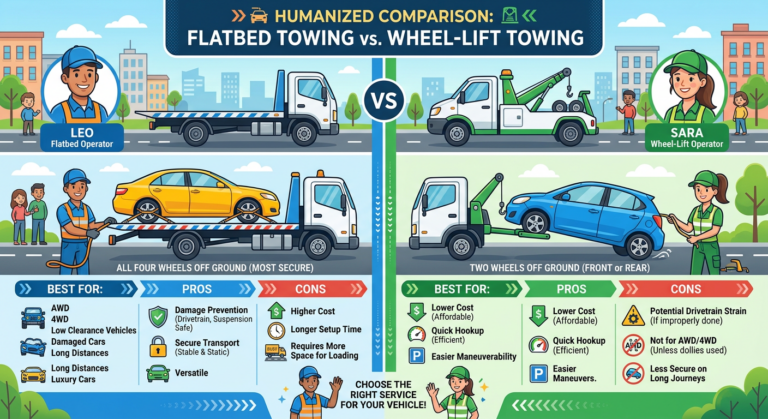
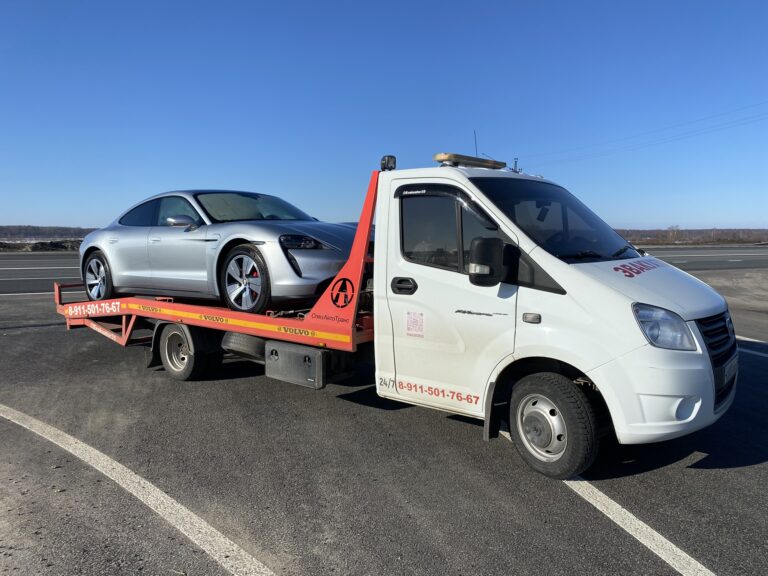
- Flatbed trucks load the entire vehicle onto a hydraulic platform — the safest option for most cars
- Wheel-lift trucks raise the front or rear wheels off the ground
- You’ll typically be allowed to ride in the cab to stay with your vehicle
- Upon arrival, the driver offloads your car and completes any paperwork
Types of Towing Services — Know the Difference
| Type | Best For | Notes |
|---|---|---|
| Flatbed towing | Most vehicles, wrecked cars | Safest — all 4 wheels off ground |
| Wheel-lift towing | Short-distance tows | Front or rear lifted |
| Hook and chain | Junked or scrap vehicles | Can cause damage — rarely used now |
| Heavy-duty towing | Trucks, RVs, buses | Specialized equipment required |
| Motorcycle towing | Bikes and scooters | Requires special cradle attachment |
How Much Does Emergency Towing Cost?
Towing costs vary significantly based on:
- Vehicle type and size — larger vehicles cost more
- Distance towed — most companies charge a hook-up fee ($50–$100) plus a per-mile rate ($2–$7/mile)
- Time of day — after-hours and weekend rates are often higher
- Your coverage — AAA members and those with roadside assistance through insurance may pay little to nothing
With an active roadside assistance plan, most standard tows come at minimal or zero out-of-pocket cost. Without coverage, expect to pay $100–$300 for a typical local tow.
5 Tips to Prevent Breakdowns Before They Happen
Prevention is always better than a roadside rescue. Follow these habits:
- Schedule regular maintenance — oil changes, fluid checks, and tune-ups per your manufacturer’s schedule
- Inspect tires monthly — check pressure, tread depth, and look for damage
- Replace your battery proactively — most car batteries last 3–5 years
- Monitor your dashboard — never ignore warning lights
- Top up fluids regularly — oil, coolant, brake fluid, and transmission fluid
For expert vehicle maintenance tips, visit Edmunds’ Car Care Guide — a trusted automotive authority that covers everything from DIY checks to knowing when to call a professional.
Final Word: Be Prepared, Stay Safe
Breaking down on the road is stressful — but it doesn’t have to be dangerous. With this emergency towing guide in your back pocket, you now know exactly what to do: pull over safely, activate your hazard lights, stay in the vehicle, call for help, and wait calmly for your tow truck to arrive.
Save this article. Share it with new drivers in your family. And always keep your roadside assistance number saved in your phone before you ever need it.

Emergency Towing Guide 2026: What to Do When Your Car Breaks Down